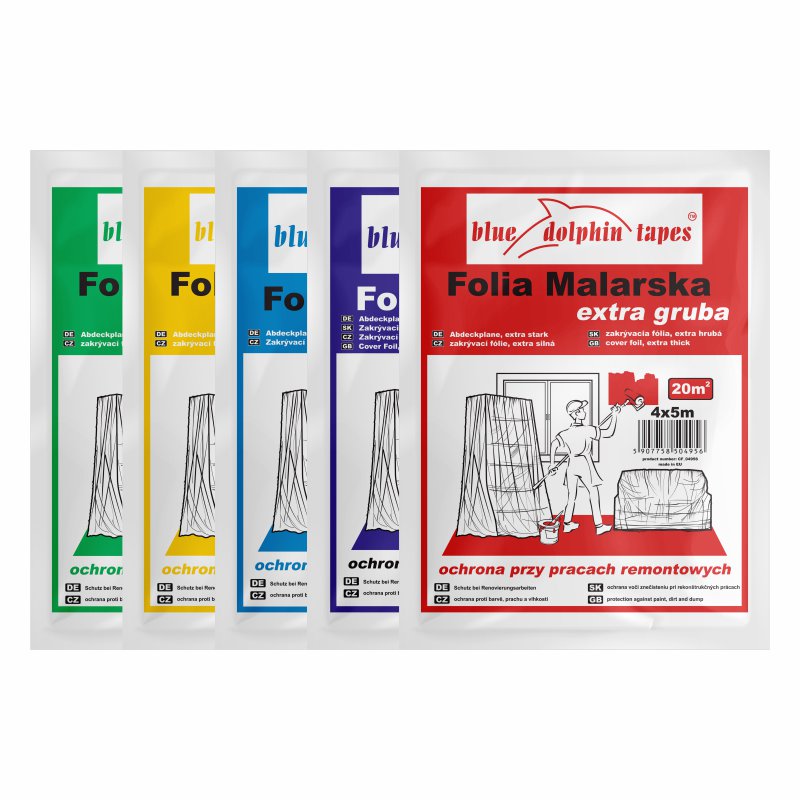
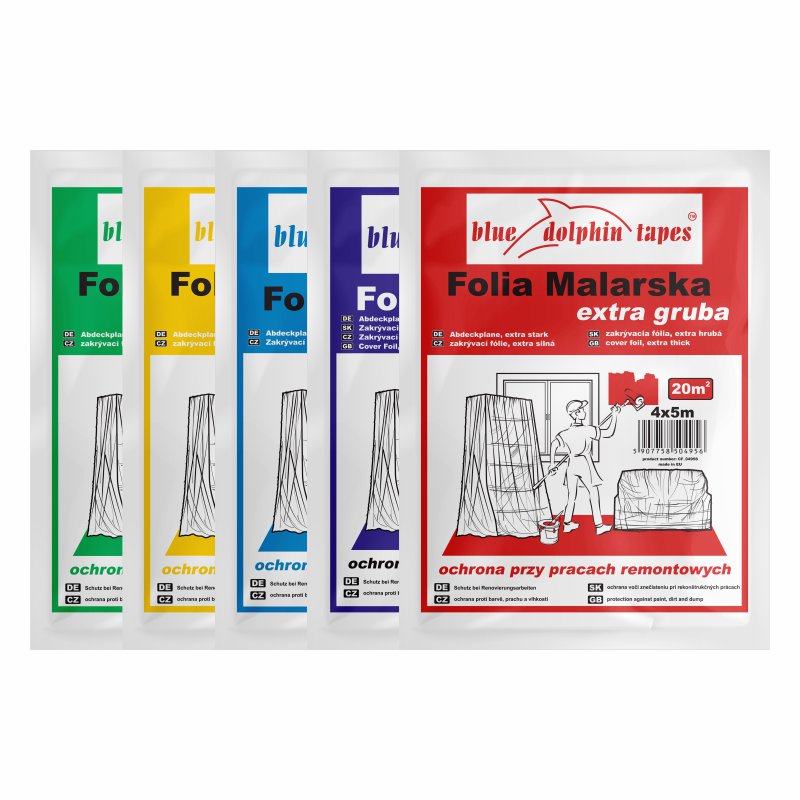
DOLPHIN PLASTERING FOIL 4*5M 20SQM
Painting foil Blue Dolphin is designed to protect various surfaces during painting and general construction works. It is used to secure large objects with irregular shapes, such as furniture. It will also work well as a window or door protector or when securing floors. Protects against paint, water, dust and dust during renovation. Properties of Blue Dolphin Paint Foil: multifunctional; protects against dirt; covering area approx. 20 m2.
Product Details
During renovation, the paint foil separates paint, dust, water and wet mortar from floors, furniture, joinery and glazing. During finishing work, it acts as a physical barrier, thanks to which it reduces permanent stains, discoloration and costly cleaning after plaster, screeds or paints have dried.
The material is thin, smooth and slippery to the touch, and it rustles slightly when unrolled. The paint protection film is odorless, easy to cut and lightweight when covering furniture, and in the thicker version, it is more stable on the floor.
What does a painter's foil give during renovation?
In practice, painting foil protects not only against paint. It also traps gypsum dust, dust, water, primer and pigments from modern emulsions, which can permanently color the absorbent substrate.
Flexible polyethylene, a moisture-resistant material, adapts to edges, handrails, chairs and furniture without breaking when pulled. Versions with higher statics adhere to vertical surfaces, so the cover blows less when ventilating interiors.
The most important benefits are:
- cleaner room after painting and shorter cleaning time,
- Reduced risk of scratching, splashing and permanent discoloration
- tighter isolation of the work area from the rest of the building.
How to choose a variant for the scope of work?
There are versions: standard, standard plus, thick, thick plus, extra thick and in a roll. Thinner sheets of disposable paint foil work well for short jobs and covering furniture, while thicker variants better withstand the movement of ladders and tools on the floor.
The 4 × 5 m format gives about 20 m² of coverage, so it quickly isolates the room from dust. Depending on the variant, you get a 4 × 5 m sheet or a 2 m wide roll. Such a paint film in a wall painting roll makes it easier to cut off long stripes.
The following are the most important factors when choosing:
- weight, because the higher it is, the greater the resistance to tearing and puncturing,
- raw material, because the material is sometimes made of pure polyethylene or as a recycled paint foil, i.e. regranulate,
- production technology, because it affects the tightness of the material and stability during operation,
- color, because the slightly blue, transparent foil makes it easier to notice shifts against the background of a white wall.
The price of paint foil increases along with its durability, but such an expense in practice reduces the cost of corrections and cleaning.
How to properly protect an apartment with paint foil before painting?
When protecting interiors, the paint protective film should cover the surface with a margin and be pressed against the edges. Only then will it act as a dust cover during renovation work and reduce the penetration of dust into adjacent rooms.
For a standard renovation, it is best to do this in four steps:
- clean and dry the substrate so that the material adheres better,
- unfold the sheet or cut the strip from the roll with a spare to wrap the edges,
- immobilize edges at moldings, frames and passages,
- check the tightness at the corners, where dust most often escapes.
For sensitive floors, such as parquet, panels or natural stone, it is safer to choose a thick or extra-thick version.
How to glue windows, skirting boards and frames without leaks?
In the case of glazing, the protective film for windows and joinery should adhere tightly to the smooth surface during painting and not wrinkle at the corners. What matters here is precision and a clean paint edge.
In this application, the self-adhesive painter's film with masking tape allows you to glue the edge and unroll the cover at the same time. For frames, the blue variant gives better contrast, so it is easier to cut the material evenly at the edge, and the transparency still lets light into the interior.
In the case of large glazing, a tighter protection is provided by combining a glass film with an additional sheet for the frame and window sill, because gypsum dust most often penetrates through the joints.
Assembly is not difficult. Simply stick the tape to a dry substrate, roll out the foil and smooth it with your hand from the center to the edges to remove air bubbles.
Key features and practical benefits
In renovation, a protective painting film makes sense when it speeds up work and protects expensive finishing elements. Variants for light household chores and stronger solutions for crews are available, including a reusable reinforced paint film that can be unfolded several times in one investment.
The variants for contractors have about 40% higher tensile strength than traditional regranulate films, so they can withstand intensive work and repeated realignment better.
The most commonly sought after product features include:
- odourlessness, which improves the comfort of work in apartments and offices,
- flexibility that makes it easy to wrap unusual shapes without breaking,
- static, which improves adhesion to walls and reduces blowing,
- transparency with blue tint, which makes it easier to control the position,
- covering area of about 20 m², which allows you to quickly separate one room.
If the question is whether one painter's film fits every job, the answer is simple: no. For furniture and short painting, a lighter variant is sufficient, and for floors and intensive work, it is better to choose a thicker version, and for windows and moldings, a self-adhesive variant.
You May Also Like
-20250131140217.jpeg)
-20250131140111.jpeg)
- Sale -33%


- Sale -50%
- Sale -44%
- Sale -33%